Emergency planning · 11 min read
Hiking first aid and emergency planning: what actually matters
Prepare for the small problems you can manage and the larger situations you need to recognise, communicate and hand over to appropriate help.
The useful takeaway
A first-aid kit is only one part of preparedness: the plan, communication, warmth, navigation and willingness to change course matter too.
Prepare before a problem exists
Emergency planning begins with a route plan that someone else can understand. Tell a trusted person where you intend to hike, who is with you, how you are travelling, when you expect to return and when they should take action if you do not check in. Update that person when the plan changes. This is not an alarmist ritual; it is a practical way to give others useful information if a delay becomes a concern.
Check local conditions, closures, weather and communication limitations before departure. Do not promise coverage you have not verified or assume that a call for help means immediate rescue. On a remote trail, know the local emergency number and the park or land-manager guidance where available. Carry navigation that helps you give a useful location, and keep your phone battery for the job it may need to do.
Build a first-aid kit around the trip
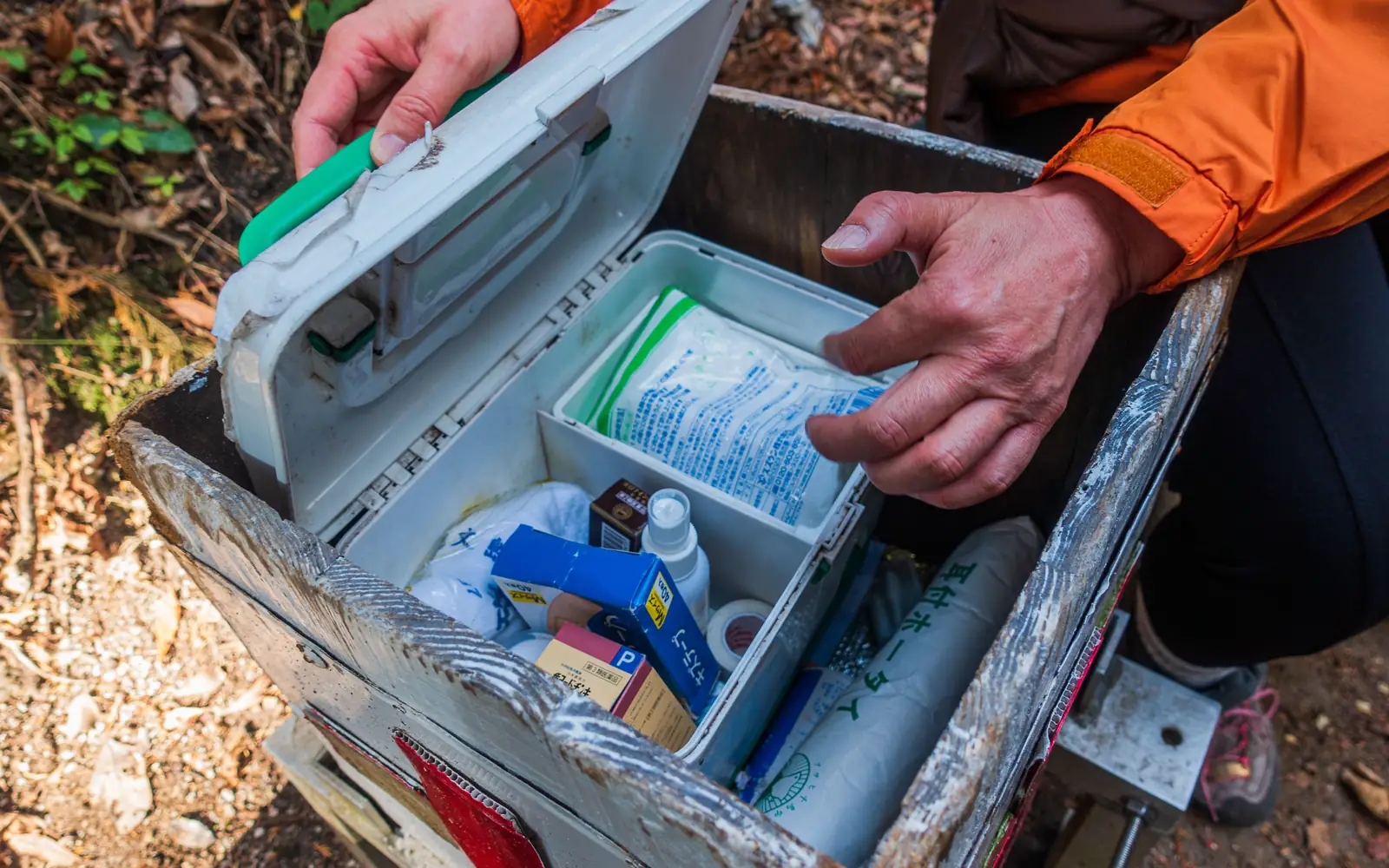
There is no one correct kit for every hike. The American Red Cross recommends tailoring supplies to factors such as climate, terrain, trip length, remoteness, group size and known personal medical needs. A short walk near a trailhead has different consequences from a multi-day route with a long exit. Personal medication and any group-specific emergency items should be planned individually rather than assumed to be in a generic kit.
Keep the kit accessible and know what is inside it. Basic supplies for small cuts, blisters, minor strains or other common problems can help when used within your knowledge and training. Take a first-aid course if you want practical skills; a guide cannot diagnose a condition or replace professional advice. Treat small issues early when continuing would turn discomfort into a bigger problem, and reassess whether the route still fits the group.
- Personal medication and any individual emergency needs.
- Supplies appropriate to common minor problems for your route and group.
- A way to manage warmth and shelter if movement slows or stops.
- Navigation, light and signalling appropriate to duration and remoteness.
Plan for delay as well as injury
A wrong turn, weather change, damaged trail, fatigue or an unexpected slow pace can create an emergency without a dramatic injury. A headlamp is useful if darkness becomes a credible consequence of delay; a phone flashlight is not a dependable substitute for a planned light source. Extra insulation, weather protection and an emergency shelter can help preserve warmth while you decide, wait or assist someone else.
Food, water and a way to communicate are part of the same margin. Their value is not only comfort. A group that is cold, thirsty or rushing to beat darkness makes worse decisions. Match the amount of redundancy to the consequences of the route rather than carrying every possible item on every short local walk.
Know when the problem is no longer yours to solve
First aid is not a promise that you can manage every situation on the trail. If a condition is severe, worsening, involves altered awareness, serious difficulty breathing, major bleeding, suspected serious injury or any situation beyond your training, seek emergency help where available. Follow the instructions of dispatchers, rangers or qualified responders. Avoid moving someone or giving treatment beyond your competence when doing so could worsen the situation.
When you need help, give clear facts: your best location, what has happened, the person’s condition as you can describe it, the weather, group size, equipment and any immediate hazards. Keep the group together unless leaving someone to seek help is the safest locally appropriate option. Preserve warmth, shelter and calm while you wait.
Use the plan to make better route choices
Emergency planning should make a hike feel more manageable, not more frightening. It clarifies the decisions that prevent trouble from escalating: start with time margin, bring the layers and water the route calls for, keep navigation available, communicate the plan and turn back when conditions no longer match it. It also makes a group conversation easier before pressure arrives.
Review the plan after a hike. Did the headlamp, extra layer or first-aid kit live where you could reach it? Did the check-in plan work? Were there places where an earlier turnaround would have made the day calmer? Small improvements make the next trip more resilient without pretending that outdoor risk can be eliminated.
Turn the topic into a practical decision
Emergency planning means deciding how the group will recognise a problem, stabilise what it safely can, communicate, shelter and either self-exit or request professional help. The useful habit is to make that decision before the route starts demanding attention. Write down what you expect, what evidence supports that expectation and what would make you change course. A guide becomes valuable when it helps you notice the moment when the original assumption no longer matches reality.
Use route-specific facts rather than identity or confidence. Experience matters, but it does not cancel weather, terrain, daylight, equipment limits or a group member having a different day than expected. Build a plan that can absorb one ordinary problem without immediately becoming urgent. If the plan only works when pace, conditions and equipment all perform perfectly, reduce the objective or increase the margin.
For repeat use, keep the decision simple enough to apply under fatigue. A short written rule is better than a vague intention: identify the trigger, the safe response and the latest point where that response remains easy. That approach also makes group communication clearer because everyone knows what would cause a pause, a change of route or a turnaround.
- Tailor first-aid supplies to route length, remoteness, group size, known personal needs and the skills people actually have.
- Tell a trusted contact the route, group and expected return where a delayed return would matter.
- Know local emergency numbers and whether mobile coverage is unreliable.
- Carry illumination and emergency warmth adequate for an unplanned delay.
- Keep personal medication accessible and verify that the group knows where critical items are.
- Discuss who will navigate, communicate and stay with an injured person if roles are needed.
Reassess while the hike is happening
Pre-trip planning is only the first pass. Once moving, compare the actual day with the assumptions you made at home. Conditions, pace, energy, water, visibility, surface and group confidence are live data. Small deviations are normal; several deviations pointing in the same direction deserve action before they compound.
When something goes wrong, slow the sequence down: protect the group from immediate danger, assess the situation and choose the lowest-risk next action. The strongest signal is often a trend rather than one dramatic event: breaks getting longer, navigation taking more time, layers staying wet, feet becoming progressively sore or the group reaching checkpoints later than planned. Use those trends to protect the later part of the route rather than spending all available margin early.
At major junctions, before exposed sections and before committing to a long return with fewer exits, stop for a deliberate check. Ask whether the route still fits the group, whether the weather window still exists and whether food, water, warmth, daylight and concentration are adequate for the next segment as well as the return.
- Move only when remaining in place creates greater danger or movement is clearly safe.
- Treat small problems such as hotspots, cold stress or dehydration early before they cascade.
- Keep the group together unless separation is necessary for safety and roles are explicit.
- Preserve battery and location information before communication becomes urgent.
- Use emergency services or SOS for genuine emergencies rather than allowing the device to justify more risk.
- Reassess after every intervention; improvement or deterioration changes the plan.
Worked scenarios to practise the judgment
Scenario 1: A hiker twists an ankle several kilometres from the trailhead but can still bear some weight. The point is not to memorise one answer for every future hike. Identify which variable changed, what information would confirm it and which option preserves the most margin. Practising that reasoning before a real problem makes it easier to act calmly rather than defend the original plan because of time already invested.
Scenario 2: The group becomes delayed by navigation and sunset will arrive before the planned finish. The point is not to memorise one answer for every future hike. Identify which variable changed, what information would confirm it and which option preserves the most margin. Practising that reasoning before a real problem makes it easier to act calmly rather than defend the original plan because of time already invested.
Scenario 3: One person becomes increasingly cold and slow during persistent rain. The point is not to memorise one answer for every future hike. Identify which variable changed, what information would confirm it and which option preserves the most margin. Practising that reasoning before a real problem makes it easier to act calmly rather than defend the original plan because of time already invested.
Scenario 4: A serious fall occurs in remote terrain with no mobile signal but a satellite SOS device is available. The point is not to memorise one answer for every future hike. Identify which variable changed, what information would confirm it and which option preserves the most margin. Practising that reasoning before a real problem makes it easier to act calmly rather than defend the original plan because of time already invested.
Common mistakes and better alternatives
Most mistakes around this topic are not caused by a complete absence of knowledge. They happen when one useful rule is applied too broadly, when a warning sign is noticed but postponed, or when the group continues because changing the plan feels inconvenient. Replace rigid rules with a repeatable process: observe, compare with the plan, decide while several safe options remain, and communicate the change clearly.
After the hike, review the mismatch between expectation and reality. Record what was useful, what was unnecessary, which assumption failed and what you would change next time. That turns one day outside into calibration for future route choices instead of relying on memory or copying someone else’s system.
- Carrying supplies without knowing how to use them.
- Assuming rescue will be immediate after an SOS activation.
- Splitting the group casually to save time.
- Waiting for a small problem to become severe before changing the route.
- Using a generic kit instead of accounting for personal medication and route hazards.
- Failing to tell anyone when the group is overdue because the original plan did not define a check-in.
Quick-reference questions
Use these questions as a compact review before a similar trip. They are deliberately practical rather than exhaustive. Local rules, current official information and individual medical or technical needs always take priority over a general guide.
- Question: What belongs in a first-aid kit? Answer: Supplies should match trip, group and training; use an authoritative checklist as a starting point and tailor it.
- Question: When should I call for help? Answer: Seek urgent help when there is a reasonable concern for life, serious injury or an unsafe inability to self-rescue.
- Question: Should an injured person always be moved? Answer: No; movement can create additional risk, so follow your training and emergency guidance.
- Question: Is a satellite messenger enough preparation? Answer: No. It supports communication but does not replace route fit, shelter, first aid or self-reliance.
- Question: What is the best emergency skill to learn? Answer: Formal first-aid training plus calm route and communication planning gives more value than carrying unfamiliar equipment.
Sources & further reading
These sources informed the planning guidance in this guide. Check official local information for your specific trail and conditions.
- Hiking & Backpacking First Aid Kit: Contents & Checklist
American Red Cross — tailoring first-aid supplies to the trip, group and personal needs
- Hiking Safety — Great Smoky Mountains National Park
National Park Service — trip plans, communication, emergency shelter, illumination and local emergency response